
As a regular Twitch viewer and an ordinary player who spends too much time in game lobbies, I thought I had a decent grasp of how global streaming fame works. Then I remembered the early 2025 moment when Asmongold, one of the platform's biggest broadcasters, was left absolutely stunned by his popularity on Bilibili. It is 2026 now, and that story still feels like a perfect example of how gaming culture ignores borders—even when platforms and politics try to draw them.
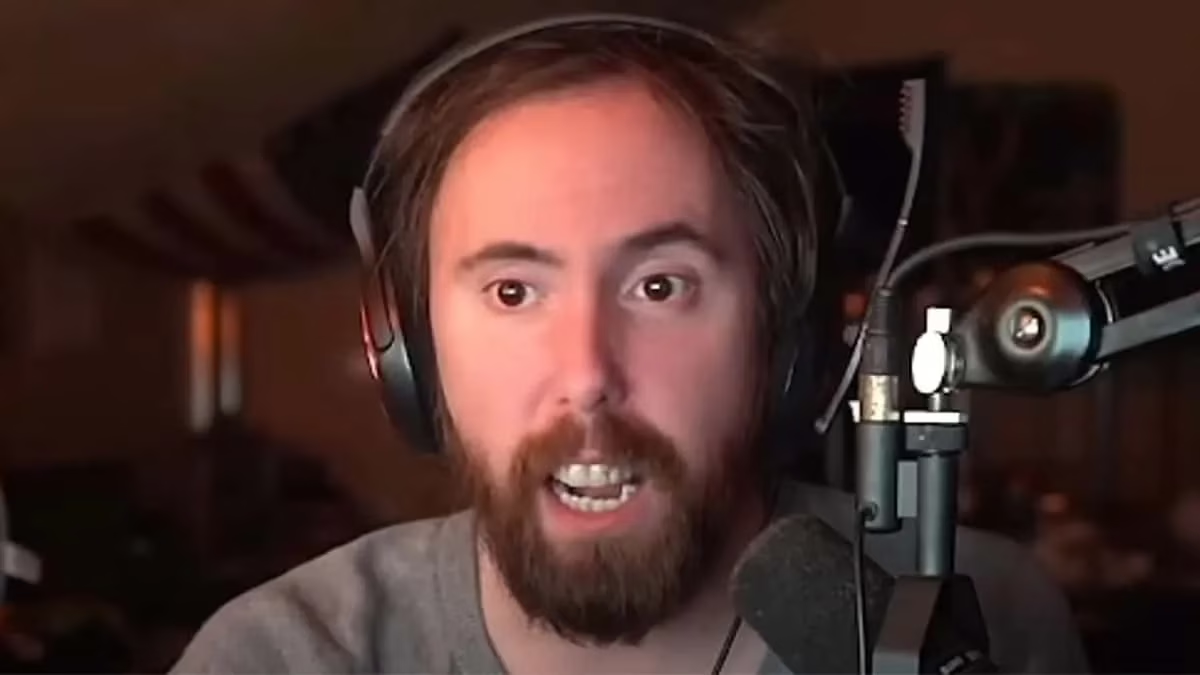
Asmongold is not a niche creator. He ranks as Twitch's fourth most-viewed broadcaster as of December 2024, and his millions of followers across YouTube and Twitch make him a household name in online gaming. But even he did not realize how many people watch him in China. During a January 2025 live stream, he was browsing his subreddit when he found a post with a screenshot from Bilibili, China's massive video-sharing competitor to YouTube. The screenshot showed that Asmongold has his own category on the site, with videos about him pulling hundreds of thousands of views each.
'Wait — 460,000 views?' Asmongold exclaimed, according to the clip. 'Oh my f*king god! And there's pages of this sht? Oh my god!' I have to admit: as a viewer, I laughed, but I also understood the shock. How many Western streamers actually know the size of their Chinese audience? More importantly, how many would ever find out if fans did not repost their content?
| Platform | Asmongold's status | Why it matters |
|---|---|---|
| Twitch | 4th most-viewed broadcaster as of Dec 2024 | Shows his mainstream reach |
| YouTube | Millions of followers | Clips and highlights travel fast |
| Bilibili | Own category, videos with 460k+ views | A hidden fanbase he did not know about |
Part of what made the Bilibili discovery so surprising was the content driving those views. A large number of the videos focused on Asmongold's thoughts about Black Myth Wukong's divisive loss to Astro Bot at the 2024 Game Awards. That award show moment sparked a huge conversation across social media. Wukong, released in August 2024, had sold over 10 million copies in just a week, and many players felt it deserved the top prize. Top gaming personalities like Shroud even said the event was 'rigged.' So when Asmongold reacted, Chinese fans clearly paid attention.
Then came the twist that made the whole situation even stranger: Asmongold had actually been banned from Bilibili for two years. He believes the ban happened because of his previous comments criticizing China. Yet somehow, his content still found an audience there. 'I was banned until Black Myth Wukong came out, and I liked it so much that they decided to unban me,' he theorized. 'They said, You know what, maybe he's not so bad.'
Can a streamer really be banned and beloved at the same time? On the internet, apparently yes. That contradiction says less about Asmongold specifically and more about how gaming fandom works in 2026. Clips get translated. Reactions get re-uploaded. A community can form around a creator even when the creator has no direct access to the platform. As an ordinary player, I see this all the time: the best moments from Western streams end up in Chinese highlight reels, and the best Chinese game discussions end up on English-speaking subreddits. The pipeline is messy, unofficial, and incredibly fast.
From my perspective, the most fascinating detail is not the 460,000 views. It is the idea that a game like Black Myth Wukong could change the relationship between a creator and a platform. Wukong was a cultural event. Its success proved that a Chinese-developed AAA game could dominate global conversations. Its Game Awards loss became a rallying point. Asmongold's genuine enthusiasm for the game apparently mattered more to Bilibili users than his past controversies. That is a strange and very modern kind of forgiveness: not official, not permanent, but algorithmic and emotional.
In 2026, I still think about what this means for streamers. If you are a creator, your audience is probably bigger than the analytics dashboard shows. If you are a fan, your favorite clip might be watched by people who do not speak your language. And if you are a platform, bans and borders are much leakier than they look. The Asmongold-Bilibili saga is a reminder that gaming culture is not contained by one website or one country. It spills over, gets subtitled, and finds new life.
Would Asmongold have ever known about his Chinese fanbase without that Reddit post? Maybe not. Would those fans have known about his Wukong takes without Bilibili? Probably. That is the weird beauty of global gaming. The same streamer who was banned for two years became a category on the very site that banned him. As a regular player, I find that both hilarious and hopeful. It suggests that the love of games—and the drama around them—can outlast almost any ban.
Data referenced from Digital Foundry helps frame why cross-border hype can spike around a single title like Black Myth: Wukong: when a game becomes a technical showcase, performance breakdowns and graphics comparisons tend to travel fast via clips and re-uploads, amplifying reaction content (like Asmongold’s) across platforms even when official access or regional availability is uneven.