
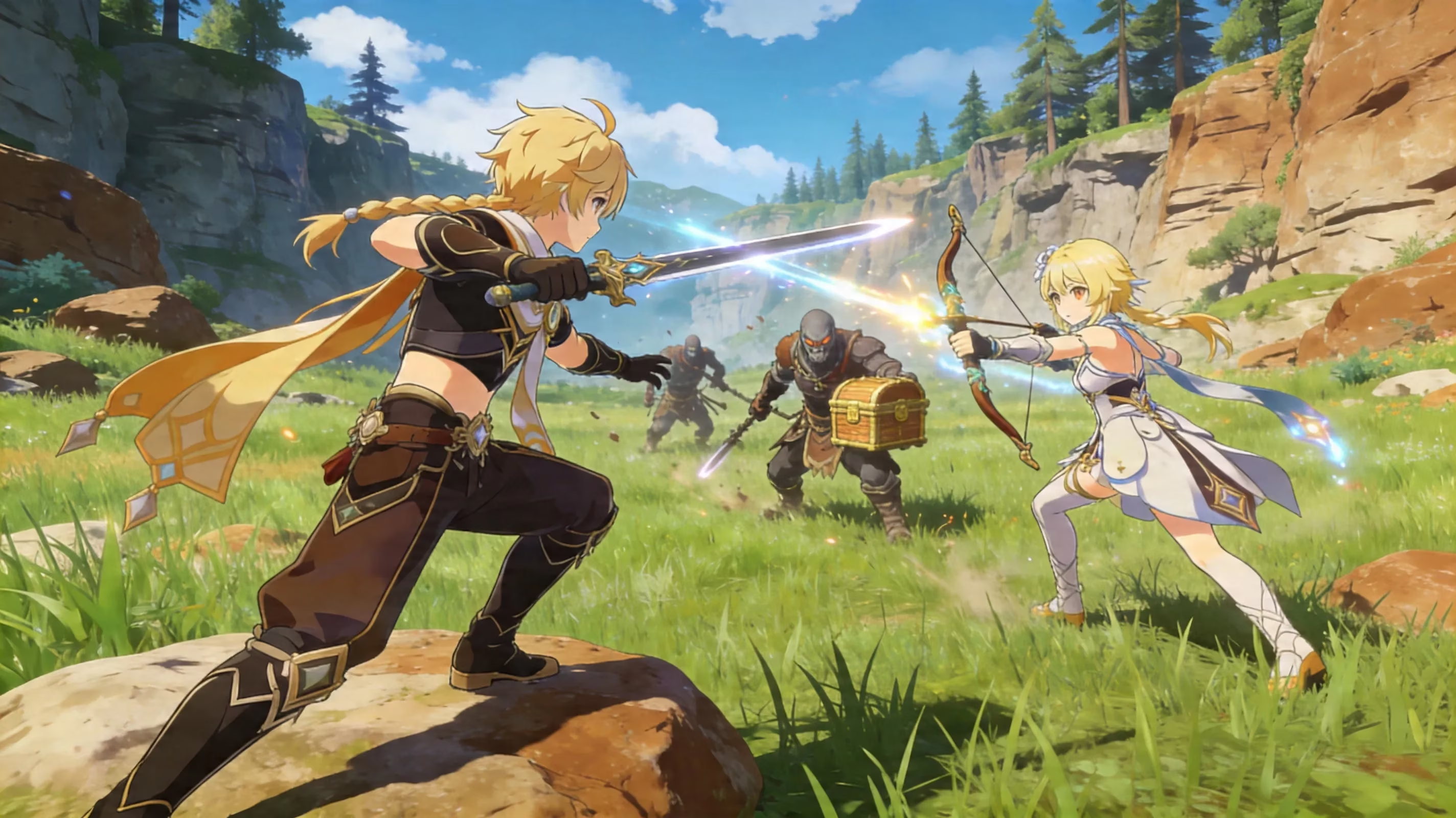
The question of whether Genshin Impact is pay to win has been around basically since launch, and in 2026 it is still one of the biggest arguments in the community. That makes sense, honestly. Teyvat is much larger now, the game runs on its steady six-week update cycle, there are eight nations to explore, several endgame modes to worry about, and more than 80 playable characters competing for your Primogems. The short answer is a little messy: Genshin does not really match the classic pay-to-win label because there is no PvP ladder or ranked mode, but spending absolutely speeds up roster growth, unlocks stronger constellation breakpoints, and makes hard content feel far less demanding. The real issue is not whether money lets you “win” in the traditional sense, but how much easier and smoother it makes the game depending on what kind of player you are.
Is Genshin Impact Pay to Win in 2026
Defining Pay to Win in a PvE Context
In most games, “pay to win” means your spending directly decides who gets to compete and who gets left behind. If we use that strict definition, then is Genshin Impact pay to win? Not really. It is a fully PvE game, there is no ranked ladder, and another player's spending does not lock you out of story quests, domains, or endgame modes. Spiral Abyss, Imaginarium Theater, and Stygian Onslaught are all available to free-to-play players. HoYoverse has also kept the game built around team synergy, reaction knowledge, and execution rather than pure wallet size.
A better way to put it is this: Genshin is pay for speed and comfort, not access. If someone spends $400 chasing a character’s C2R1 setup, they are going to clear Floor 12 with fewer retries, fewer rotations, and way less pressure on execution. Meanwhile, an F2P player using C0 characters and craftable weapons can still get the same clear, but the margin for error is smaller. You need better artifacts, cleaner rotations, and a stronger read on enemy behavior. The ceiling is still there for everyone. The difference is how hard you have to work to reach it.
The Whale Gap vs. Clearability
The most obvious spending gap shows up in constellations. A C6 Raiden Shogun or a C2 Alhaitham holding his signature weapon simply does more damage than the baseline C0 version, and in optimized setups that increase can land somewhere around 30% to 50%. That part is real.
What matters, though, is where that advantage actually shows up. Community clears keep proving that C0 five-stars are enough for the hardest content in the game. So yes, whales have a huge edge, but it usually lives in the gap between a relaxed 36-star Abyss run and a speedrun-level clear. For most players chasing rewards rather than leaderboard-style bragging rights, that gap is noticeable but not game-breaking.
Genshin Impact Gacha Value and Pity Reality
Character Pity, 50/50, and Carryover
If you want an honest answer to whether Genshin feels pay to win, you have to look at the gacha first. The character event banner has a hard pity of 90 pulls, with soft pity kicking in around pull 74. In practice, most players see their five-star arrive somewhere between 74 and 85 pulls. Then there is the 50/50 system: your first five-star on a limited banner has a 50% chance to be the featured character, and if you lose, the next five-star is guaranteed to be them.
That means the true worst-case cost for a limited five-star is 180 pulls, or 28,800 Primogems. The good news is that pity and guarantee status carry over between banner phases of the same type, so your progress is not lost when one banner ends. That carryover is a big reason patient F2P players can still plan around the system instead of getting completely crushed by it.
Weapon Banner Cost Trap
The weapon banner is where things get rough. Hard pity sits at 80 pulls, and the Epitomized Path system can force you to miss your target twice before finally guaranteeing the weapon you actually want. In the worst case, that means 240 pulls, or 38,400 Primogems.
For an F2P account, that is brutal. You are often spending months of savings for a damage gain that usually lands around 25% to 40% over a strong four-star option. That is meaningful, sure, but it is rarely worth the opportunity cost. This is why the common advice has not changed: if you are F2P or even a light spender, the weapon banner is usually a trap.
Constellations vs. Signature Weapons and 2026 Pull Income
Constellations push the spending ladder even higher. Varka, who arrived in Version 6.5, is a good example. His C1 gives roughly a 34% DPS jump over C0, which makes it feel almost mandatory if you care about squeezing out competitive numbers, while C6 changes how his entire rotation works. Across the roster, some units get huge quality-of-life or utility spikes from early constellations — Bennett at C1 is the classic example — while others are perfectly fine at C0 and would rather have their signature weapon. Either way, the system is clearly built to encourage spending beyond just getting the base character.
On the income side, a very active F2P player in 2026 earns around 5,500 to 8,000 Primogems per month, or about 34 to 50 wishes. Per six-week patch, the realistic range is around 8,960 to 11,080 Primogems, which works out to roughly 56 to 74 wishes depending on events, Abyss performance, and how much new content you clear. So if you save properly and skip the weapon banner, guaranteeing one featured five-star every two to three patches is very realistic.
| Income Source | Monthly Primogems (Approx.) |
|---|---|
| Daily Commissions | 1,800 |
| Spiral Abyss (full clear) | 1,200 |
| Events (variable) | 1,500–4,000 |
| HoYoLAB check-in | 60 |
| Exploration & quests | 500–1,000 |
| Total (active player) | 5,500–8,000 |

F2P vs Spenders in Real Endgame
Spiral Abyss Clear Expectations
Spiral Abyss resets twice a month, on the 1st and 16th, and gives up to 1,200 Primogems monthly if you can secure all 36 stars. Plenty of community data shows that players do clear Floor 12 without paid characters. So the mode is not locked behind spending.
What it does ask for is account quality. You want proper artifact sets, correct main stats, and ideally at least a couple of useful substats on each piece. You also need to understand reaction priority and team flow. A well-built Vaporize, Hyperbloom, or Freeze team can absolutely outperform a newer spender who pulled a meta five-star but left them at Level 70 with weak artifacts. In Genshin, money helps, but account management still matters a lot.
Imaginarium Theater Roster Pressure
Imaginarium Theater is where the conversation gets more interesting. Since its Version 4.7 debut and later refinements, the mode has pushed players toward wider roster depth through rotating elemental restrictions. You cannot just hyper-invest into two carries and call it a day.
This is probably the clearest place where spending creates a real F2P disadvantage. Not because whales automatically do more damage, but because they have more options. If you have pulled limited five-stars across several elements, building eight strong units is much easier. F2P players can still manage it, but they usually have to lean harder on four-stars, spread resources carefully, and plan investments with way more discipline.
Stygian Onslaught Gear Checks and Comfort vs. Speed
Stygian Onslaught is basically a gear-check mode with rotating mechanics, and it offers up to 450 Primogems each patch cycle. It rewards polished artifacts, strong supports, and tightly built teams. The important distinction here is not “can clear” versus “cannot clear.” It is comfort clears versus speed clears.
A spender can brute-force a lot of the pressure by using stronger weapons, better constellations, and higher raw damage. An F2P player can still full clear, but usually with more farming and more careful execution. Reaching that same endgame level without spending takes real time. Conservatively, fully engaged accounts are putting in something like 10 to 15 hours a week if they want to stay on pace.
Best F2P Teams That Still Work
National Core
The National core — Xiangling, Bennett, Xingqiu, plus a flex slot — is still one of the best low-cost teams Genshin has ever had. Xiangling is free once you clear Spiral Abyss Floor 3 Chamber 3, and Bennett and Xingqiu have both been widely available through standard pulls and event rewards. The team works because it stacks reliable off-field Pyro and Hydro application, letting Vaporize do the heavy lifting.
Even now, through Version 6.5, National remains a benchmark for cheap Abyss value. It is consistent, proven, and way stronger than its cost suggests.
Hyperbloom Core
Hyperbloom is probably the best F2P-friendly archetype in the current meta. The usual setup is a Dendro applicator like Nahida or Collei, a Hydro unit, and an Electro trigger such as Fischl or Kuki Shinobu. The reason it is so efficient is simple: Hyperbloom damage scales mainly from the trigger’s Elemental Mastery. So a four-star like Kuki with stacked EM can create massive damage without needing expensive five-star investment.
Nahida, who has been available through the standard banner as of Version 6.x, pushes the team much higher with stronger Dendro application and EM sharing. But even without her, the core reaction loop is already strong enough to carry budget accounts through serious content.
Freeze or Taser Flex
Freeze teams and taser teams are still solid budget picks when the matchup is right. Freeze, built around Cryo plus Hydro, can lock down non-boss chambers very effectively. A Rosaria or Kaeya setup with Xingqiu is still perfectly workable. Taser teams, meanwhile, use units like Fischl, Beidou, and a Hydro support to deal steady off-field damage while keeping field time demands low.
These teams are especially forgiving if you are still getting used to rotations. They also work well with four-star weapons like The Catch, Favonius options, and Sacrificial weapons. In most cases, the gap between those and five-star signatures is only around 15% to 25%, which is a pretty manageable loss for the amount you save.
-
National core: Cheap, reliable, and still excellent for Abyss
-
Hyperbloom: Massive value from EM scaling and low-cost triggers
-
Freeze/Taser: More matchup-dependent, but very effective with the right chamber lineup
-
4-star weapons: Still enough for near-maximum performance in many teams
Who Feels Genshin Is Pay to Win
Whether Genshin feels pay to win depends a lot on who is playing. Different players run into very different pressure points.
New accounts usually feel it the hardest at first. Your roster is thin, your pity is not built up, and every banner seems to feature something you cannot afford. Rerun FOMO hits especially hard in the first six months, because missing a character can mean waiting a long time for another shot.
Meta chasers are the group most likely to call the game pay to win. If your standard is C2R1 builds, Abyss speedruns, or damage benchmark screenshots, then yes, spending matters a ton. The highest numbers almost always come from five-star constellations and signature weapons, and getting those on demand usually means opening your wallet.
Casual explorers have a completely different experience. If you mainly care about story, open-world exploration, Archon Quests, and some co-op, the spending pressure is almost nonexistent. The game’s core content is very accessible, and even the starter roster can get you through a huge amount of it.
Welkin players probably sit in the best middle ground. The Blessing of the Welkin Moon costs about $5 per month and gives 90 Primogems daily for 30 days, or 2,700 total, plus 300 Genesis Crystals upfront. That is an enormous bump for a small cost. Pair it with the Battle Pass and you are looking at roughly 90 to 106 wishes per patch cycle, which is enough to target limited five-stars consistently without diving into weapon banner nonsense or constellation chasing.
Genshin Impact Spending Verdict and FAQ
Best Value: F2P, Welkin, Battle Pass
If you are trying to figure out where spending actually makes sense, the value ladder is pretty clear. Pure F2P works for all content if you are willing to put in the time. Welkin Moon at $5 per month is easily the best Primogem value in the game. The paid Battle Pass, at $10 per six-week cycle, adds more Primogems along with talent books, weapon materials, and other progression resources.
Together, those two options cost about $15 a month and can push your pull income past 100 wishes per patch. That is enough to make banner planning much less stressful and gives you a realistic shot at securing the characters you care about each version.
Skip Points: Weapon Banner
For most F2P and low-spend players, the weapon banner is the easiest skip in the game. The 240-pull worst-case cost for a specific five-star weapon is already bad enough, and Epitomized Path fate points reset when the banner ends, which makes the risk even worse.
Signature weapons do matter. A 25% to 40% DPS gain is not nothing. But for full endgame rewards, that extra damage is usually a luxury rather than a requirement. Unless your roster is already in a very comfortable spot, character pulls almost always bring better value.
Is Genshin Impact Pay to Win: FAQ
Q: Can F2P players clear all endgame content?
Yes. Spiral Abyss Floor 12, Imaginarium Theater, and Stygian Onslaught can all be cleared without paid characters. You will usually need better execution, stronger artifacts, and smarter team building, but the content is not locked behind spending.
Q: Does spending money make you win anything F2P players cannot?
No. Since Genshin has no PvP or ranked mode, spending does not buy a victory state that free players are denied. What it buys is convenience, faster clears, higher damage ceilings, and broader roster coverage.
Q: Is it worth spending at all?
If you play regularly, Welkin Moon is honestly great value and makes saving for priority characters much easier. Beyond that, spending is more about preference than necessity.
Final Verdict by Player Type
Genshin Impact in 2026 is best described as pay for comfort, not pay to win. F2P players can still access every mode, earn full endgame rewards, and build strong teams around four-star units plus smart pull planning. Spenders shorten the grind, reduce the execution burden, and unlock constellations or weapons that push teams closer to their max potential, but they are not buying access to a separate win condition.
That PvE structure is the key reason the game avoids being truly pay to win. Spending buys time, flexibility, and smoother clears. If you are a min-maxer, that can feel huge. If you are mostly here for exploration, story, and solid clears without chasing perfection, it matters way less.
As detailed in OpenCritic, discussion around whether a game is “pay to win” often hinges on what constitutes “winning” in the first place; in Genshin Impact’s PvE structure, spending tends to translate into faster roster expansion, stronger constellation breakpoints, and smoother endgame clears rather than exclusive access to content. Framing it as “pay for comfort” better captures the reality that disciplined artifact farming, team synergy, and reaction execution can still achieve full rewards without purchases, even if whales reduce retries and tighten clear times.