
In the ever-shifting digital landscape of 2026, where rumors spread like wildfire across the wires, a whisper caught my ear—a whisper of a knight from Bohemia, his armor clanking not on cobblestone, but on the vibrant, chaotic shores of a battle royale island. The air is thick with speculation, a familiar scent in the gaming world, yet this particular blend is peculiar. It carries the earthy smell of medieval mud and the electric ozone of futuristic gunfire. I find myself contemplating this potential collision of worlds, where the meticulously researched grit of Kingdom Come: Deliverance 2 might meet the kaleidoscopic, pop-culture frenzy of Fortnite. It feels as improbable as finding a perfectly preserved manuscript in a neon-lit arcade, its vellum pages glowing under blacklight.
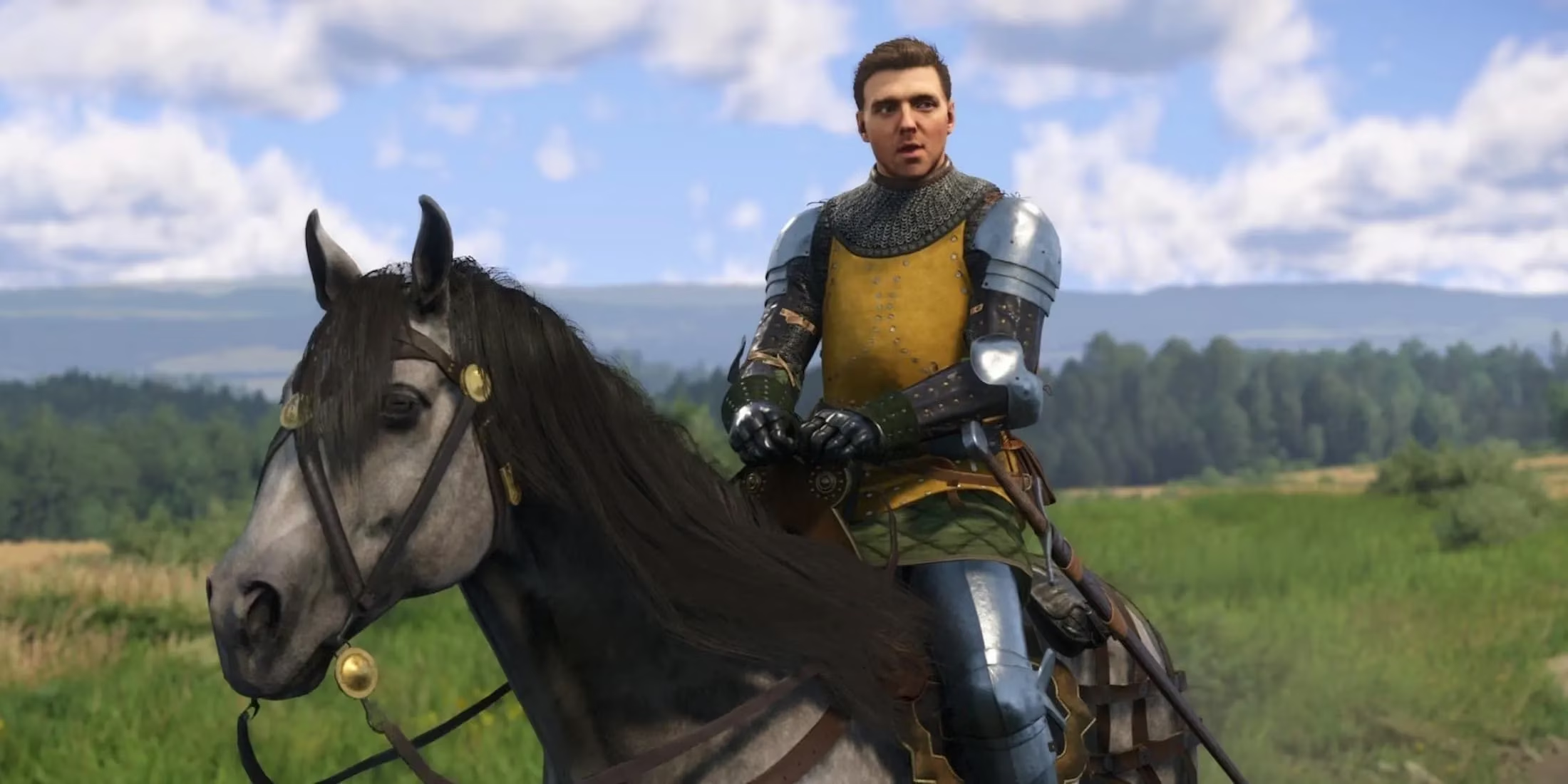
The source of this modern fable was a leak, a list promising crossovers as varied as the stars. Names like Doom: The Dark Ages and Death Stranding were whispered alongside our humble knight, Henry of Skalitz. The community's reaction was a tapestry of emotions, woven with threads of confusion, excitement, and sheer disbelief. To many, the idea was as jarring as hearing a Gregorian chant suddenly drop a bassline in a packed nightclub. Kingdom Come: Deliverance 2 is not just a game; it is an immersive historical simulation, a painstaking recreation of 15th-century Bohemia where every sword swing has weight, every conversation matters, and mud will genuinely stain your trousers. The thought of Sir Hans Capon, a nobleman obsessed with his own prestige, wielding a purple-rarity Rocket Launcher is an image that exists somewhere between hilarious heresy and creative genius.
Warhorse Studios, the custodians of this historical world, responded not with a confirmation or denial, but with a playful, pointed question directed at Epic Games. This single post, like a stone dropped into a still pond, sent ripples through the rumor mill. Suddenly, the entire leak was cast in a dubious light. Was it all a carefully constructed fantasy? The developer's tone suggested a bemused detachment, as if watching someone try to fit a full suit of plate armor into a sports car. This interaction served as a potent reminder: in an age where information travels at light speed, discernment is our most valuable armor.
Let's consider the inherent contrast of such a crossover:
| Aspect | Kingdom Come: Deliverance 2 | Fortnite |
|---|---|---|
| Core Philosophy | Historical Authenticity & Immersion | Pop-Culture Carnival & Accessible Fun |
| Combat | Deliberate, skill-based, melee-focused | Fast-paced, gunplay-centric, building mechanics |
| Aesthetic | Grimey, realistic, earthy tones | Vibrant, cartoonish, constantly evolving |
| Player Goal | Survive and thrive in a believable world | Be the last one standing in a chaotic spectacle |
The chasm between these two experiences is vast. For the devoted fans of Kingdom Come, their connection to Henry is one of struggle and growth. He is not a superhero; he is a blacksmith's son who must painstakingly learn to read, fight, and navigate a complex social hierarchy. Dropping him into Fortnite would be like transplanting a centuries-old oak tree into a zero-gravity chamber—the fundamental rules of its existence would no longer apply. The visceral, personal journey of becoming a knight would be reduced to a cosmetic skin, his hard-earned longsword swapped for a Mythic Pulse Rifle.
Yet, is there not a strange, poetic beauty in this absurdity? Fortnite's island has become a contemporary cultural archive, a living museum where Batman, Goku, and Ariana Grande coexist. Adding a historically accurate medieval warrior would be its most audacious anachronism yet. Imagine the emotes: Henry clumsily attempting the "Orange Justice" or solemnly polishing his helmet. The potential for humor is immense. Perhaps this crossover wouldn't be a betrayal of Kingdom Come's spirit, but a celebration of its iconic status—a tip of the visor from one wildly successful game to another, acknowledging that in the vast realm of interactive entertainment, there is room for both profound simulation and playful parody.
As I reflect on this, the initial leak now feels like a shared dream the community experienced—vivid, compelling, but ultimately intangible. Warhorse's response has gently guided us back to reality. The true fate of Henry remains in the realistic, strife-torn lands of Bohemia, where his battles are fought with fealty and steel, not with loot chests and victory royales. Meanwhile, Fortnite continues its relentless march through the zeitgeist, its next collaboration always just over the horizon. While the knight may never truly land on the island, the mere discussion of it has been a fascinating thought experiment, a reminder of how games can inhabit such wildly different spaces in our hearts and minds. One offers an escape into a meticulously recreated past; the other offers an escape with the entirety of the present's pop culture. Both are valid, both are magical in their own right, and their hypothetical meeting will remain one of gaming's most charmingly odd "what if" tales.
So, I sheath my speculation. The rumor, like a morning mist over Rattay, has dissipated under the sun of official inquiry. Yet, the image persists—a lone knight, standing bewildered on a rainbow hill, watching a giant banana skydive towards him. It’s a surreal postcard from a universe that doesn't exist, and perhaps that’s exactly where its magic lies.